
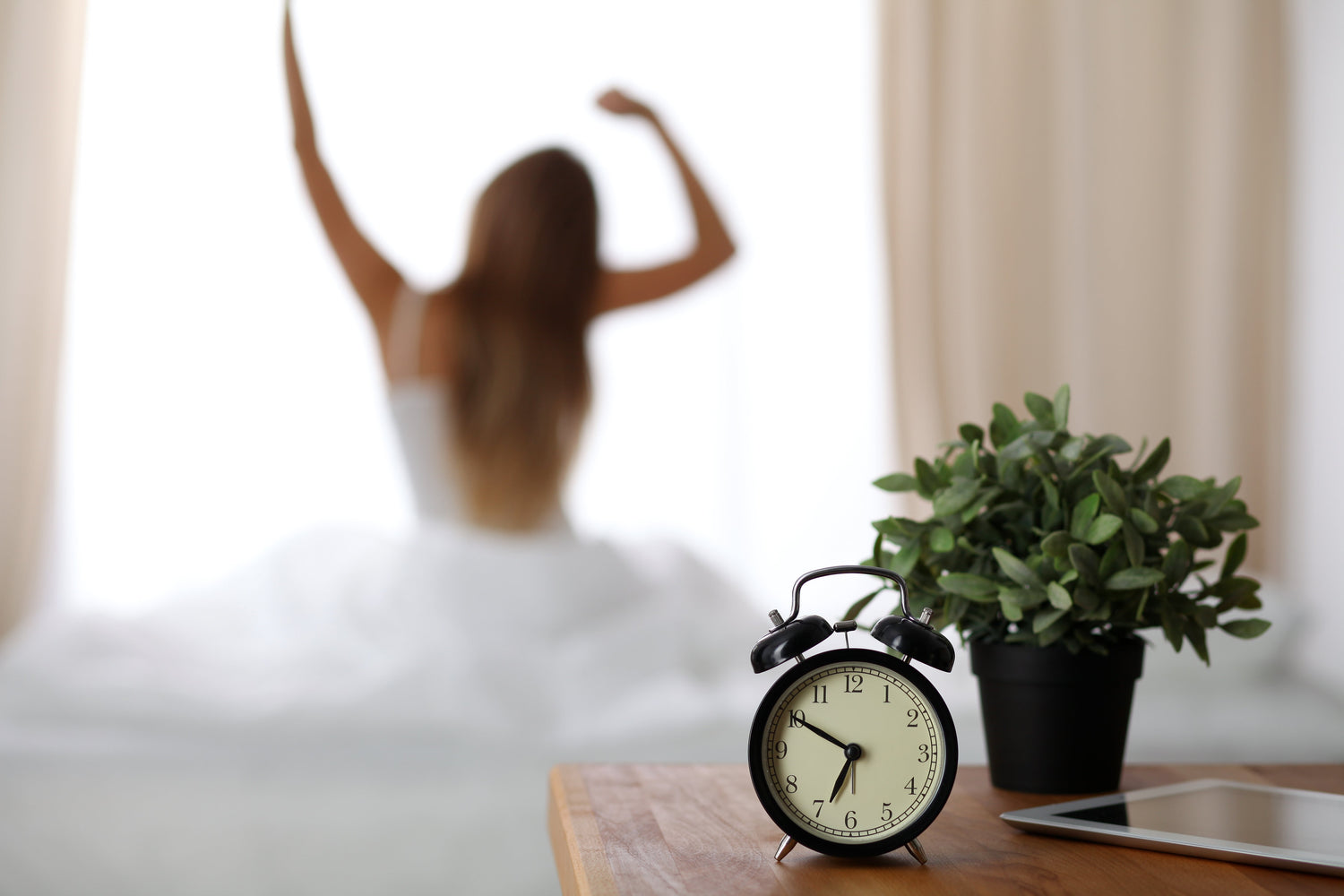
When the alarm goes off again
In the summer, everything somehow slips a little later.
We stay up later, have dinner later, the evenings are longer, and during holidays, we often turn off our alarms altogether. Within a few weeks, our bodies can easily get used to this more relaxed rhythm.
Then September arrives.
Work, school, kindergarten, morning preparations – and suddenly we have to jump out of bed feeling fresh around 6–7 a.m. again.
It’s no wonder that in the first few days, this doesn’t go quite so smoothly.
However, instead of trying to "force" ourselves back into the old routine overnight, it is worth gradually helping our body adjust to the transition.
Why does our sleep rhythm easily get disrupted in the summer?
The timing of our sleep is regulated in part by our internal biological clock, or circadian rhythm.
This is influenced by, among other things:
- the alternation of light and darkness,
- the time we go to bed and wake up,
- the timing of our meals,
- physical activity,
- and our evening habits.
In the summer, it stays light longer, we organize more evening programs, and our daily routine often becomes more relaxed. Because of this, the time when we naturally begin to feel sleepy can easily shift to a later hour.
1. Don’t try to adjust in a single night
If you've been going to bed around midnight all summer, there’s little chance you’ll suddenly fall asleep at ten o'clock on August 31st.
A gradual approach may work better.
A few days before school or work starts, try to move your bedtime and wake-up time 15–30 minutes earlier each day.
This gives your body time to adapt to the new rhythm.
For children, it can be especially useful to start resetting the usual evening routine the week before school starts.
2. Seek out light in the morning
One of the easiest ways to signal to your body that the day has begun is through natural light.
After getting up:
- open the curtains,
- go outside for a few minutes,
- have breakfast in a bright spot,
- if possible, take a short walk outdoors.
This can be particularly helpful when those darker autumn mornings are hard to get through.
3. Conversely, start winding down in the evening
Just as morning light supports waking up, it is worth creating an increasingly calm environment in the evening.
About an hour before bedtime, try to:
- dim bright lights,
- put work away,
- spend less time on your phone or computer,
- choose more calming activities.
You don’t need to organize a perfect "wellness evening" every day.
It makes a big difference just to establish a simple, repetitive sequence.
Shower – tea – reading – sleep.
If you end your day the same way every evening, eventually the routine itself will signal to your body that it is time to rest.
4. Don't let your phone move into bed with you
"I'll just scroll for five minutes."
Then, suddenly, forty minutes have passed.
Using your phone in the evening is problematic not only because the screen light keeps us active until late, but also because the constant flood of information can make it difficult for the mind to slow down.
If possible, try to:
- not charge your phone by the bed,
- use a separate alarm clock,
- or at least put the device away half an hour before bed.
The goal isn't digital abstinence – just to give your brain a little time to wind down from the day.
5. A little evening tea can also be part of the routine
A warm drink isn't a sedative on its own, but it can be a pleasant part of winding down in the evening.
Among caffeine-free herbal teas, many people enjoy:
- lemon balm,
- lavender,
- chamomile.
Making tea can even become a small evening ritual: a few minutes where you are not planning tasks for the next day, but slowly bringing the day to a close.
Bio-Friend Tip 💚
Choose a caffeine-free herbal tea for the evening. Lemon balm, lavender, or chamomile can be a pleasant part of a calmer evening routine, especially if you set aside screens while drinking it.
6. It is worth being careful with late-afternoon coffee
The effects of caffeine can last for several hours.
Therefore, it may happen that even if you don't feel particularly alert by evening from an afternoon coffee, it can still affect your ability to fall asleep or the quality of your sleep.
If you have trouble falling asleep, it’s worth observing what happens for a few days if you skip caffeine in the afternoon hours.
Instead of coffee, you could choose:
- decaffeinated coffee,
- rooibos tea,
- herbal tea.
7. It is also worth paying attention to magnesium
Magnesium is involved in hundreds of physiological processes and contributes, among other things, to:
- normal nervous system function,
- normal muscle function,
- maintenance of normal psychological function,
- and the reduction of tiredness and fatigue.
Natural sources include, for example:
- nuts and seeds,
- legumes,
- whole grains,
- leafy green vegetables.
Bio-Friend Recommendation 💚
If you would like to consume magnesium as a dietary supplement alongside your diet, you could choose magnesium bisglycinate. However, dietary supplements do not replace a balanced diet and proper sleeping habits.
8. The bedroom matters too
It’s not just about when we go to bed, but also about the environment we sleep in.
Most people rest better in a:
- dark,
- quiet,
- pleasantly cool,
- well-ventilated bedroom.
At the end of summer, this can be especially important, as evenings can still be warm.
A quick airing out of the room before bedtime often makes a surprising difference.
9. For children, the evening should be predictable
It's not just adults whose sleep rhythm can be disrupted when school starts.
After long summer evenings and later bedtimes, children may also need time to adjust.
It can help if things happen in a similar order every evening:
dinner → bath → brushing teeth → story → sleep.
A predictable routine provides security and can help ensure that bedtime doesn't turn into a new round of negotiations every night.
10. Don't let the weekend disrupt everything
On the first Friday of September, it might be tempting to switch back to summer mode and sleep until noon on Saturday.
A little lounging around is fine, of course, but if we deviate too much from our weekday rhythm over the weekend, the transition starts all over again on Monday.
It’s worth going to bed and waking up at roughly the same time on weekends as well.
It doesn’t need to be exact to the minute; it’s enough that your usual daily schedule doesn’t slip by several hours.
A simple 30-minute evening routine
It doesn’t have to be complicated.
30 minutes before bed: phone and laptop away.
20 minutes before: shower or skincare routine.
15 minutes before: herbal tea, soft music, or reading.
5 minutes before: ventilate the room, lights out.
Sleep.
If this happens in a similar order every night, it can become natural within a few weeks.
Summary
After summer vacation, it is not always easy to return to your previous sleep rhythm. After late nights, it takes time for earlier bedtimes and wake-up times to feel natural again.
The biggest factor isn't a single "sleep trick," but rather many small habits combined:
morning light, regular bedtime, less screen time in the evening, a suitable environment, and a predictable evening routine.
And perhaps this is one of the most important lessons of starting over in September: we don't have to get back up to full speed in a single day.
Frequently Asked Questions
How long does it take for the sleep rhythm to reset?
This varies by individual. Generally, it is worth leaving several days or even a few weeks for the body to gradually adapt to the new schedule.
How should we prepare for school in terms of sleep?
If possible, start gradually moving your child's bedtime and wake-up time earlier a few days or a week in advance.
What should we drink in the evening instead of coffee?
Decaffeinated coffee, rooibos, or lemon balm, chamomile, or lavender tea can all be pleasant alternatives.
Does magnesium help with an evening routine?
Magnesium contributes to the normal function of the nervous system and the maintenance of normal psychological function. However, sleep problems should not be attributed solely to magnesium deficiency.
What should we do if we can't sleep well for a long period?
If difficulty falling or staying asleep persists for a long time, significantly affects your daytime functioning, or is accompanied by other complaints, it is advisable to seek help from a doctor or other appropriate professional.
Bio-Friend Tip 💚
Don’t introduce ten new rules to your evening routine at once. Start with two: put your phone away half an hour before bed, and go to bed at roughly the same time every night. Once that has become natural, you can add tea, reading, or a few quiet minutes just for yourself. 🌙


Leave a comment
All comments are moderated before being published.
This site is protected by hCaptcha and the hCaptcha Privacy Policy and Terms of Service apply.