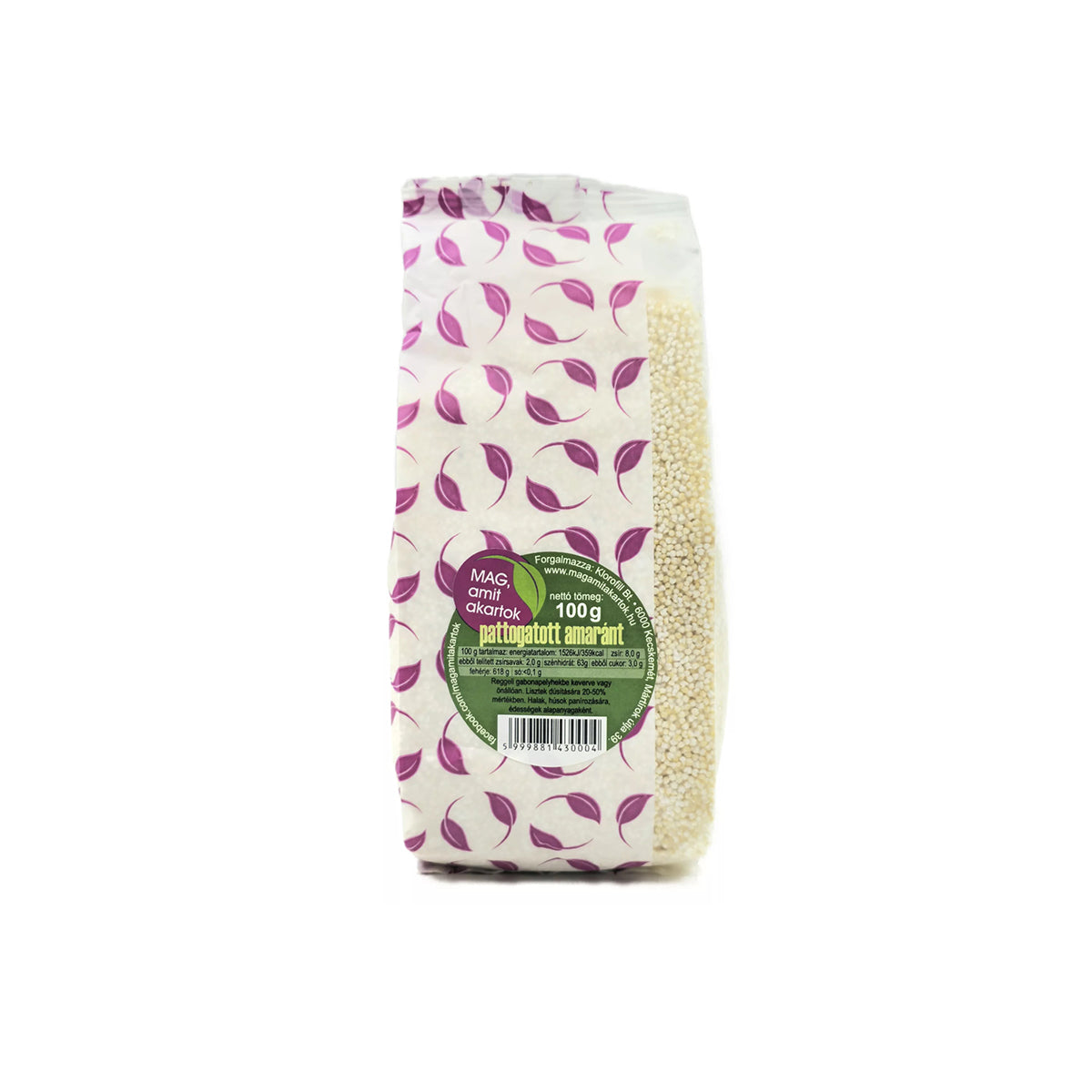
Puffed Amaranth in Vacuum Packaging - 100g
VIA GLS COURIER SERVICE
- You can pay the courier in cash or by credit card upon delivery, but you can also pay via Apple Pay or credit card on our website
PICK UP IN OUR STORES
- Pick up your order without shipping costs, regardless of the amount, as early as the same day in the designated Bio-Barát stores
- You can view the list of stores by clicking here
- We prepare your package almost immediately, so you can finish your shopping quickly
Inventory Information
- Blaha Lujza tér / EuropeumOut of Stock
- Gazdagrét (Budawest)In Stock
- HűvösvölgyiIn Stock
- Jászai / Szent István körútIn Stock
- Keleti PályaudvarOut of Stock
- Margit körútOut of Stock
- MOM ParkOut of Stock
- Móricz Zsigmond körtérOut of Stock
- Nyugati térIn Stock
- OktogonOut of Stock
- Pólus CenterOut of Stock
- RózsakertOut of Stock
- SavoyaOut of Stock
- Váci útIn Stock
- Zenit CorsoIn Stock
- Árkád BudapestIn Stock
- Árkád GyőrIn Stock
- Árkád (Szeged)Out of Stock
Detailed product description
Popped amaranth seeds with a uniquely complex nutrient content, high in calcium, magnesium, and iron. A true treasure of the Incas. Amaranth is one of the oldest cultivated plants on Earth, having witnessed the rise and fall of the Aztec and Inca empires. It originates from the same regions as corn, potatoes, peppers, tomatoes, and beans. Before the discovery of America, it was a staple food source for the indigenous peoples alongside corn and beans, much like grains are in modern-day Europe. Its intentional cultivation dates back 5,000 to 6,000 years. Its importance at the time is supported by records stating that Montezuma, the last Aztec ruler, received 5,000 tons of corn and 3,700 tons of amaranth seeds as annual tribute from his subjects. In addition to them, it was also cultivated by the Mayans, Incas, and other pre-Columbian peoples. The conquerors who followed Columbus gifted the Old World many new plant and animal species, but they left quite a few behind as well. Amaranth was one of them. The reason for this may have been that the indigenous people considered it a sacred plant that provided physical, mental, and spiritual strength—as it turns out later, not without reason. To the conquerors arriving from Christian Europe, amaranth was seen as a tool of barbaric rituals (e.g., its flour was mixed with human blood and eaten during religious ceremonies). Cortez "solved" the problem by strictly punishing even its cultivation. Amaranth retreated into the remote mountain villages of South and Central America, where its cultivation never ceased, and it was here—fortunately for modern humans—that it survived the several hundred years until its "rediscovery." Thanks to the people living isolated from the world, researchers in America had a starting point. Research began in the United States in the mid-70s, coinciding with the establishment of an amaranth center to coordinate cultivation. Its acclimatization in Hungary dates back about 15 years, and in the early 90s, a state-recognized Hungarian variety was successfully developed. Due to a lack of local awareness, its cultivation has so far been entirely for export. Uniquely complex nutrient content! The amino acid composition of amaranth is harmoniously balanced, resulting in excellent protein utilization (75%). Animal studies confirm that the biological value of the raw seed's proteins is higher than even the most well-known protein sources, which can be further enhanced by heat treatment. Amaranth is an excellent source of iron, calcium, magnesium, zinc, and other trace elements. Considering not only grains but all our important plant-based foods, the iron content of amaranth is outstanding in both quantity and biological availability. This is not only of interest to vegetarians, for whom obtaining iron is an "Achilles' heel" of their diet, but also to all those suffering from iron deficiency, who make up 20% of the world's population. Its calcium content should also be highlighted; it not only exceeds that of milk, but in terms of biological availability, it is the best calcium-source food. The magnesium content of amaranth is orders of magnitude higher than that of grains, which has a beneficial effect on maintaining mental clarity and heart muscle function. These nutritional values are made even more valuable by the fact that amaranth is gluten-free, making it accessible to those with celiac disease. An endless range of uses There are several ways to incorporate it into our diet: The raw, whole seed, boiled and lightly seasoned, makes an excellent side dish similar to buckwheat porridge. Its flour can replace wheat flour in leavened doughs at a rate of 5-10%, and in other cases at 10-50%. Packaging: 100g
Ingredients: popped amaranth
Average nutritional value per 100g of product:
Energy: 1526kJ/359kcal
Fat: 8g
Of which saturates: 2g
Carbohydrates: 63g
Of which sugars: 3g
Protein: 618g
Fiber:
Salt: <0.1g